How to Build a Crypto Marketing Strategy from Scratch

Crypto marketing didn’t just evolve in 2025, it broke, reset, and reassembled itself in public.
Entire playbooks that once worked reliably stopped working in a matter of weeks. InfoFi promised permissionless distribution, then collapsed under AI spam and reply farming almost overnight. A single policy change on X erased months of carefully constructed strategies. At the same time, institutions moved steadily in the opposite direction, expanding their footprint through ETFs, stablecoins, custody solutions, and on-chain infrastructure. That shift raised expectations across the board: credibility mattered more, compliance became unavoidable, and product quality was no longer optional.
This tension defines crypto marketing today. Attention is still fragmented, but tolerance for noise is gone. Distribution channels are fragile. And users, especially non-crypto-native ones, expect products and messaging to feel closer to Web2 than early Web3 experiments.
That’s why a crypto marketing strategy in 2026 can’t be copied from the last cycle. The best crypto marketing strategies today are built to survive volatility, platform changes, and audience fatigue, not to chase short-term hype.
To understand why crypto marketing looks the way it does today, it helps to zoom out and look at where the broader Web3 market is heading.
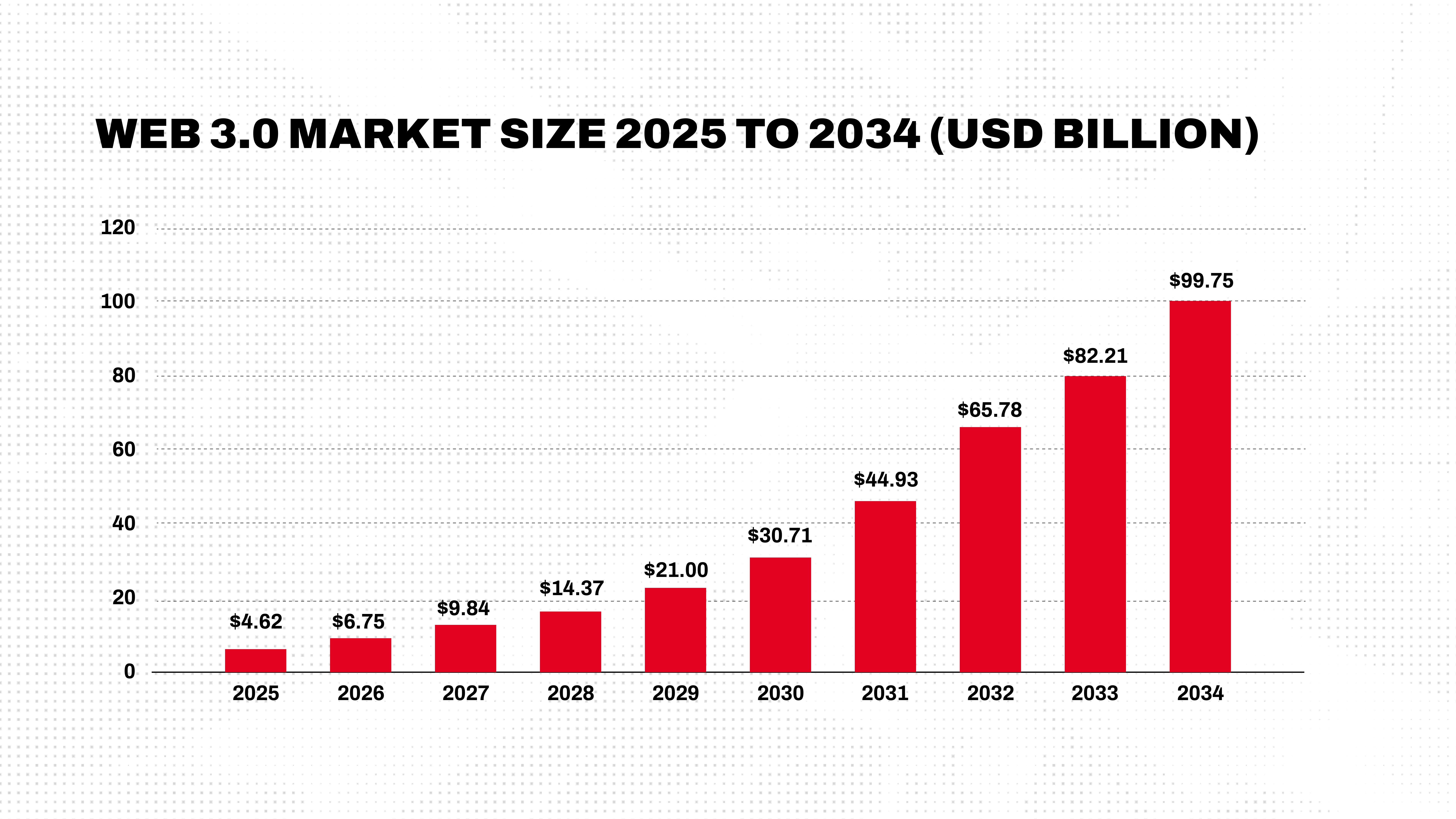
According to data from Precedence Research, the global Web 3.0 market is projected to grow from $4.6B in 2025 to nearly $100B by 2034. That’s more than a 20x increase over the next decade, driven by steady adoption across finance, infrastructure, consumer applications, and enterprise use cases.
What Blockchain Marketing Actually Supports
At its core, blockchain marketing is how crypto and Web3 projects communicate, build trust, and grow inside decentralised ecosystems. Unlike traditional marketing, it operates in an environment where transparency is expected, data is public, and users are naturally skeptical.
A blockchain marketing agency or blockchain marketing company typically helps projects with:
Positioning complex products in a way users can actually understand
Building trust after years of rug pulls, failed launches, and overpromising
Reaching crypto-native audiences across Telegram, Discord, X, and on-chain communities
Supporting fundraising, launches, and adoption without relying on empty hype
This is why blockchain marketing agencies exist in the first place. Web2 playbook breaks quickly in Web3, and generic digital agencies usually underestimate how fast narratives turn or how unforgiving the audience can be.
Define the Target Before You Define the Strategy
Before you think about channels, campaigns, or tactics, you need to answer a simple question that most teams avoid: Who is this actually for?
Crypto-native users, Web2 users, and institutions behave very differently. They evaluate risk differently. They tolerate jargon differently. They even use different channels.
In 2026, more projects will be forced to simplify because their audience is no longer just people who already understand crypto. If your onboarding feels confusing or your messaging assumes too much prior knowledge, marketing won’t save you.
This is where a lot of crypto marketing plans quietly fail. Teams build a cryptocurrency marketing strategy around growth goals without checking whether the product and message can support that growth. And in the opposite direction, without a clear blockchain strategy, even strong messaging struggles to convert attention into long-term usage.
Clarity here shapes everything that follows from your crypto strategy to how aggressive your campaigns can be.
Product Marketing vs. Token Marketing (Don’t Mix These Up)
One of the most common mistakes in crypto marketing strategy is treating product marketing and token marketing as the same thing. They’re not, and confusing them usually attracts the wrong users, the wrong incentives, and the wrong expectations.
Product marketing is about usage and retention. It answers simple questions: What problem does this product solve? Who is it for? Why should someone keep using it next week, not just today? This is where you focus on UX, real workflows, and how your dApp fits into a user’s daily behavior.
Token marketing, on the other hand, is about ownership and incentives. It revolves around utility, governance rights, emissions, rewards, and how value flows through the system. This kind of messaging speaks to a very different audience, one that cares about mechanisms, alignment, and long-term participation.
When these two get blurred, things go sideways fast. You end up onboarding users who are only there for incentives, while real users stay confused about what the product actually does. Metrics get distorted too, price action and hype start masking weak retention and low real usage.
A real-world example of this risk played out with Almanak. During their TGE, token-related dynamics overshadowed product usage, and incentives pulled in capital that wasn’t aligned with long-term participation. The result was a sharp drop in TVL from roughly $69M down to around $5M and a difficult recovery afterward. The team later acknowledged the issue publicly, pointing to misaligned incentives and messaging as part of the problem. Once expectations are set the wrong way in crypto, it’s extremely hard to reset them.
Keeping product and token narratives clearly separated doesn’t mean running them in isolation. It means being intentional. Product marketing should optimise for activated users and retention. Token marketing should optimise for governance participation, sustainable incentives, and aligned ownership. When each has its own story, audience, and success metrics, both sides perform better, and credibility stays intact.
Core Strategies for Effective Crypto Marketing
With the foundation in place, it’s time to look at how crypto marketing actually gets executed. A strong crypto marketing strategy pulls together funnel design, content, community, distribution, and experimentation into one system. The sections below break down how teams approach each part in a way that reflects how users really discover, test, and adopt Web3 products today.
The Full-Funnel Crypto Marketing Framework
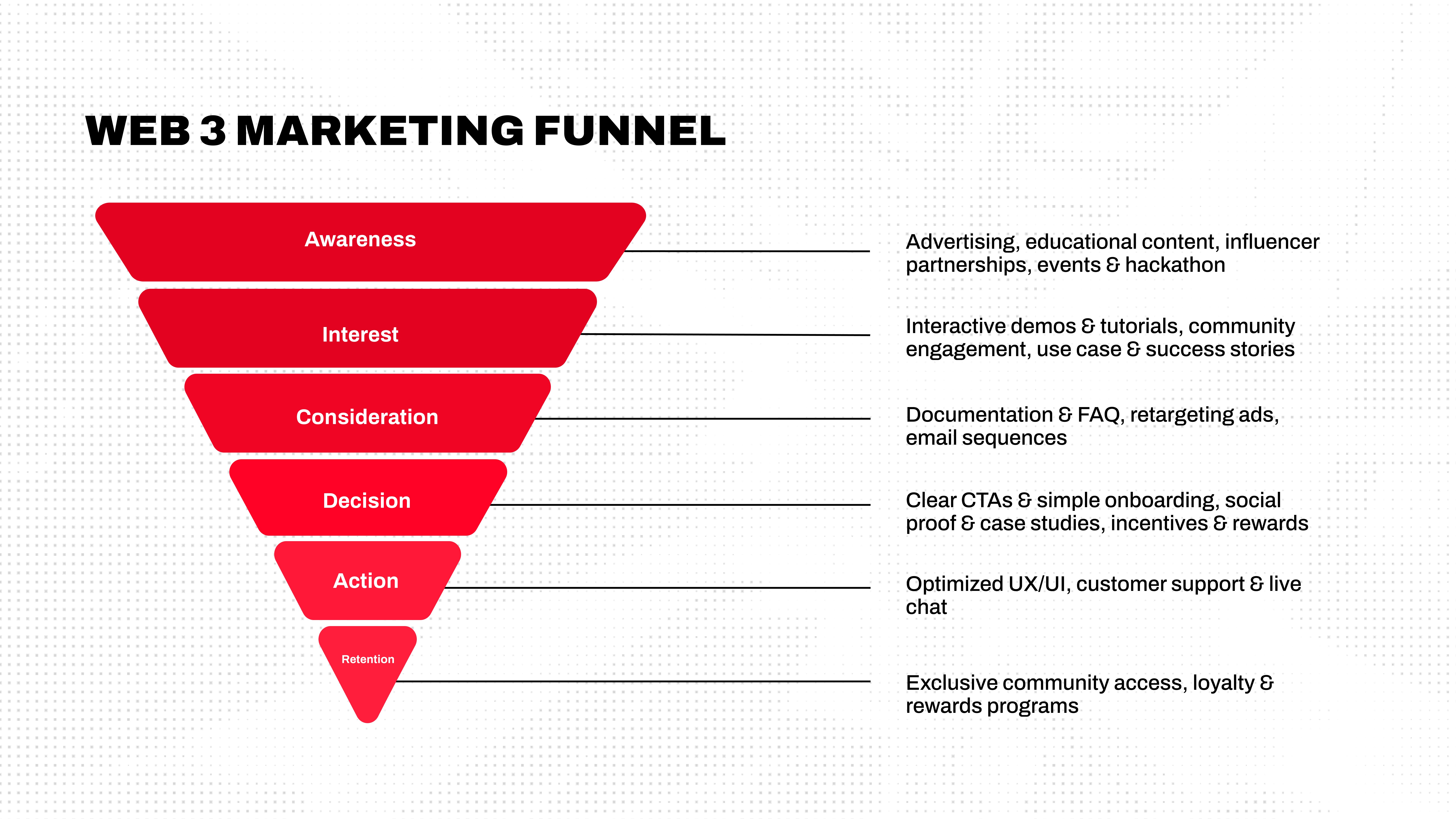
Most best crypto marketing strategies today follow a simple truth: people don’t convert in one step. They circle your product and lurk. They test with small amounts. They watch how you behave when things go wrong. Your funnel needs to support that reality.
Top of funnel: Awareness
Awareness isn’t about going viral for the sake of it. It’s about relevance. Short-form video, crypto Twitter, niche Telegram groups, podcasts, and ecosystem newsletters are doing far more heavy lifting than generic ads. The goal here is recognition. People should start seeing your name often enough that it feels familiar, not forced.
Mid-funnel: Education, proof, and trust-building
Once someone knows you exist, they don’t jump straight to depositing funds or using your app. They read threads. They skim docs. They check who’s backing you and who’s already using you. This is where content marketing, crypto SEO, and blockchain marketing and PR matter. Blog posts, explainers, demos, AMAs, and third-party coverage all serve one job: reduce uncertainty. Strong teams treat this stage as the backbone of their cryptocurrency marketing plan, not an afterthought.
Activation: Let users try without fear
Testnets, small minimum deposits, clear onboarding, no jargon, and fast feedback loops matter more than promises. Users want to experience the product before believing the narrative. This stage often separates serious blockchain marketing agencies from noise merchants, because it requires tight alignment between marketing and product.
Retention: Where most teams stop paying attention
A lot of crypto marketing campaigns end right after launch. That’s a mistake. Retention is driven by updates, transparent comms, community engagement, and showing progress even when things aren’t perfect. Discord, Telegram, email, and long-form updates start to matter more than Twitter impressions here. This is where marketing for blockchain companies quietly succeeds or fails.
Advocacy: Let users do the talking
The final stage is people. Power users writing threads, sharing dashboards, helping newcomers, and defending the product during rough market conditions. This is how the best crypto marketing campaigns compound over time. You don’t buy this stage with budget; you earn it by delivering consistently.
Content Marketing & Crypto SEO
After the InfoFi collapse and AI-content fatigue, organic discovery quietly regained importance.
Most users don’t land on your product page because they saw a banner ad. They arrive after searching questions like “how does this protocol work?”, “Is this legit?”, or “What’s the difference between X and Y?” Content is what earns that first touch. SEO is what makes sure it shows up.
Good crypto content does 3 things at once. It explains complex ideas clearly, signals credibility to a skeptical audience, and compounds over time instead of disappearing after 24 hours. Blog posts, explainers, comparisons, and technical breakdowns often outperform short-form hype when it comes to sustained traffic and qualified users.
Crypto SEO itself is less about keyword stuffing and more about intent. Search engines reward depth, clarity, and authority, especially in a space filled with thin, recycled takes. Projects that consistently publish original insights, protocol-level explanations, and honest analysis tend to win long-term visibility, even in competitive SERPs.
Another shift in 2026: content no longer lives only on your site. High-performing teams repurpose core ideas across blogs, X threads, newsletters, and long-form posts, all pointing back to a central narrative. This creates a feedback loop where content fuels SEO, SEO fuels credibility, and credibility lowers friction everywhere else in the funnel.
Community Building
Community sits at the centre of any serious crypto marketing strategy. Long before paid distribution or polished campaigns matter, the community determines whether a project earns trust, survives early volatility, and compounds attention over time. Most Web3 products launch before they are fully finished, which means early users are not just customers but contributors, testers, and advocates.
Twitter, Discord, and Telegram still form the backbone of community activity, but each plays a different role:
Twitter (X): where narratives form publicly announcements positioning, reactions, and social proof
Discord: the project’s working space for updates, support, governance discussions, and deeper engagement
Telegram: a faster, more informal channel, often preferred by global or mobile-first audiences
Strong community management focuses less on noise and more on direction. The goal is to help users understand what to do next and why it matters. In practice, that usually means:
Responding quickly and clearly to questions and issues
Feeding product feedback back to the team and closing the loop publicly
Maintaining a steady cadence of updates so people don’t lose context
Running purposeful events like AMAs, test phases, or community calls
Tracking retention and participation quality, not just member counts
Paid Advertising
Paid advertising still has a place in crypto marketing, but it works best when expectations are clear. Ads don’t create trust on their own, and they rarely turn cold users into long-term participants. What they can do is support moments that already matter, like launches, major updates, ecosystem announcements, or content that’s proven to resonate organically. A thoughtful crypto advertising strategy works best when it supports organic traction rather than trying to manufacture demand from scratch.
In practice, paid campaigns tend to work best when they’re tightly scoped. Retargeting users who already know the brand, promoting educational content, or reinforcing third-party coverage usually performs better than direct “use this now” calls. Paid spend should shorten the path for users who are already interested, not force interest where none exists.
Video Production
Video plays a central role in how crypto projects communicate today. As attention shifts toward short-form platforms and visual storytelling, video has become one of the fastest ways to explain products, shape narratives, and reach audiences beyond crypto-native users.
Strong video content usually falls into a few familiar patterns: explainers that simplify complex ideas, demos that show real product usage, storytelling pieces that connect the product to a real problem, and shorter clips designed to travel well across social feeds. Viral formats matter here, but they work best when they’re grounded in a clear message rather than pure shock value.
Video also helps carry context and tone. A founder explaining a decision, a walkthrough of a new feature, or a story told through real user examples often builds more trust than written copy alone. These formats make projects feel more real and easier to evaluate.
Influencer Marketing
Influencer marketing can still be a valuable part of a crypto marketing strategy, but it only works when it’s approached with clear intent. In Web3, influencers aren’t just distribution channels; they actively shape perception. Many users rely on them as filters for deciding what’s worth paying attention to, especially in a market saturated with low-quality launches and recycled narratives.
The most effective crypto marketing campaigns tend to collaborate with influencers who already operate within a clearly defined niche. A DeFi-focused creator, a developer known for deep technical threads, or a trader respected for long-form analysis each attracts a very different type of audience. Aligning the influencer’s expertise with the product is far more important than chasing raw follower counts. This is where experienced blockchain marketing agencies often add the most value, helping teams avoid mismatched partnerships that may look impressive on paper but fail to deliver meaningful engagement or conversions.
Influencer programs tend to work best when roles are clear:
Larger accounts help with reach and awareness
Mid-sized creators explain the product and use cases
Smaller, highly trusted voices often drive actual participation
Content format plays a major role in performance, as livestreams, product walkthroughs, podcasts, and Twitter Spaces consistently outperform heavily scripted promotional posts. Audiences tend to respond more positively when influencers are given the freedom to speak in their own voice and genuinely interact with the product, because authenticity builds connection. When messaging feels forced or overly controlled, it quickly signals paid promotion, which weakens trust and ultimately undermines the broader blockchain marketing strategy.
This makes due diligence essential. Engagement quality, past promotional behavior, and audience authenticity matter far more than headline metrics like follower count. The crypto space is filled with fake followers and short-term shilling, and the damage caused by a single poor partnership can outweigh months of thoughtful brand building. Clear disclosures and accurate claims help protect both the project and the influencer, especially as regulations surrounding blockchain marketing and PR continue to tighten.
Conclusion
Building an effective strategy crypto marketing in 2026 requires more than copying pasta playbooks. Markets move faster, audiences are sharper, and credibility takes longer to earn. Teams that succeed focus on clarity, alignment, and steady execution rather than short-lived spikes.
The strongest strategies connect product, messaging, community, and distribution into one system that can adapt over time. When marketing reflects how people actually discover, evaluate, and use crypto products, growth becomes more durable and easier to sustain.
If you want to keep reading insights like this, subscribe to the Radarblock Newsletter. We share practical growth frameworks and daily crypto news, without the fluff.