Airdrop Marketing Strategy for 2026: What Actually Works
In today’s crowded airdrop market, standing out is less about scale and more about precision, especially as the broader airdrop coin market becomes increasingly competitive.
Not all airdrops are created equal. Some create genuine believers, kickstart organic usage, and leave behind communities that continue to grow long after the tokens are claimed. Most, however, do the opposite; they farm wallets, drain treasuries, and disappear without leaving any lasting impact.
In 2026, the difference between a successful airdrop marketing campaign and a forgettable one has very little to do with budget or buzz. It comes down to design. With every project racing to launch something, users have become smarter, sybil behavior more sophisticated, and attention far harder to earn. The old copy-paste airdrop playbooks simply don’t hold anymore.
This guide breaks down how airdrops evolved, why most of them fail, and what actually works today. Whether you’re planning your first airdrop or trying to fix a failed one, you’ll walk away with clearer mental models, sharper strategy, and a more realistic way to measure success in the current airdrop market.
Why Airdrops Became a Growth Primitive
Airdrops didn’t start as a core growth strategy. Early success stories shaped expectations across the coin market airdrop landscape, setting a precedent that many teams later tried to copy without understanding the underlying mechanics.
Airdrops used to be a side quest, a way to build hype or reward early users. But as user acquisition costs increased and loyalty became harder to earn, airdrops evolved into something more fundamental. Instead of paying platforms for impressions, projects started paying users directly. The logic was simple: if users are the network, why not incentivize them directly? For a while, this worked extremely well. Projects like Uniswap, ENS, and Blur demonstrated that a well-timed airdrop could bootstrap liquidity, create network effects, and define early behavior.
But like every effective crypto strategy, success led to saturation. As more teams copied the model, the signal weakened. What once felt novel slowly turned into noise.
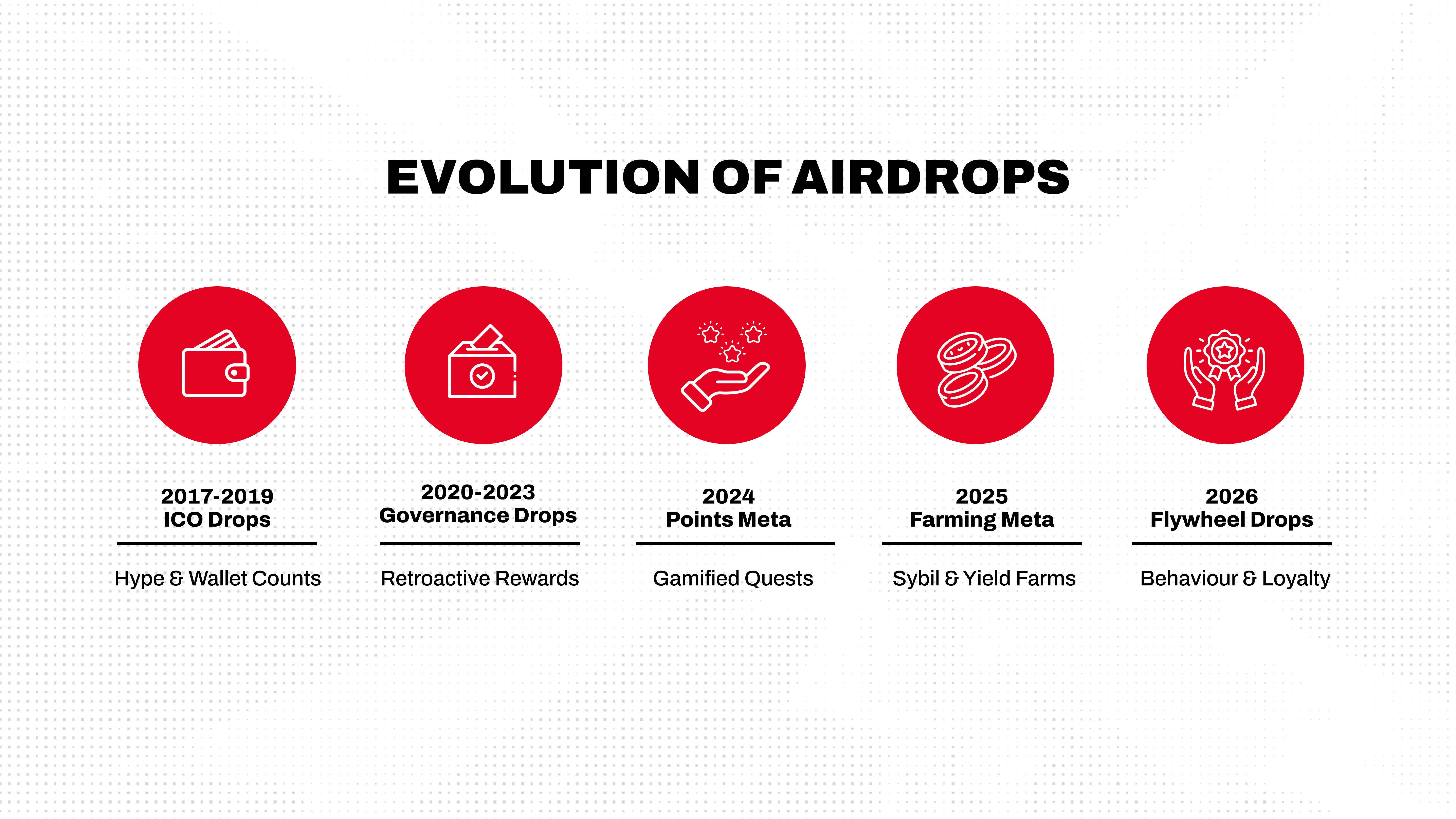
The Evolution: From 2017 ICO Hype to 2026 Design Systems
The 2017 era was simple: airdrop tokens, hope for virality. The 2020–2022 cycle got smarter with DeFi usage-based drops. Then came the 2023–2024 points meta think Blur, EigenLayer, FriendTech, where users farmed by the millions for a chance at retroactive rewards. By 2025, everyone was doing it, and users caught on. That brings us to 2026: airdrops are now designed like products. They use behavior-based scoring, user segmentation, and embedded feedback loops. It’s less about “who used the app” and more about “who contributed meaningfully.”
Why Most Airdrops Fail
It’s not the sybils, it’s the incentives. Most airdrops don’t fail because people game them. They fail because the team didn’t define success. Was it user growth? Liquidity? Retention? Governance? Without a clear north star, every metric looks good on paper but means nothing.
The second reason is timing. Airdrops work best when they reinforce existing traction, not when they try to manufacture it. If you need airdrops to generate your first users, you’re probably not ready.
The Principles That Matter in 2026
Effective airdrops today are built on a few first principles:
Behavior: Reward intent, not presence. Filter tourists from power users.
Progression matters: Single drops are forgettable. Ongoing programs build habits.
Sybil resistance is layered: Passport stamps, social graphs, spend thresholds, not perfect, but additive.
Design for post-drop: What happens the day after? Build retention into the claim experience.
Distribution: Treat token supply like a budget. Don’t overspend on one phase.
Keep rewarding: Some users will stay and others will drop after the first airdrop. Make sure you recognize the first ones and keep some extra incentives for them.
Frameworks That Actually Work
The most effective airdrop marketing campaign designs blend behavior-based rewards with clear post-drop retention paths rather than treating distribution as a one-time event.
There’s no one-size-fits-all model, but the best campaigns tend to blend a few archetypes:
Retroactive Quests: Reward historical actions, but filter for depth, not just activity.
XP Systems: Let users earn over time, but cap farming and reset incentives each season.
Referral Loops: Only works when the product has a natural word-of-mouth appeal.
Social Graph Filters: Use lens/farcaster/x ties to measure embeddedness, not just reach.
Onchain Footprints: Analyze spend, gas, staking, not just connects and swaps.
Measuring What Matters
Drop design is only half the story. The real edge is in measurement. Don’t just look at wallets claimed or tokens distributed. Track:
Retention curves: How many claimed users came back?
Liquidity ratios: Did your airdrop deepen supply-side activity?
Voting impact: Are new holders participating in governance?
Onchain actions: What % of tokens were staked, bridged, or LP’d?
This is where most teams underinvest. Post-drop dashboards are often an afterthought. In 2026, they should be built alongside the airdrop.
What We’re Seeing Across the Market
Projects that win today are treating airdrops like GTM strategies, not giveaways. They’re layering in referral quests, embedding social UX, and building token sinks early. Some tie airdrop eligibility to product usage streaks. Others distribute in batches based on behavior tiers. The best are combining KYC-lite filters with intent scoring to find the users they actually want long term.
What To Avoid
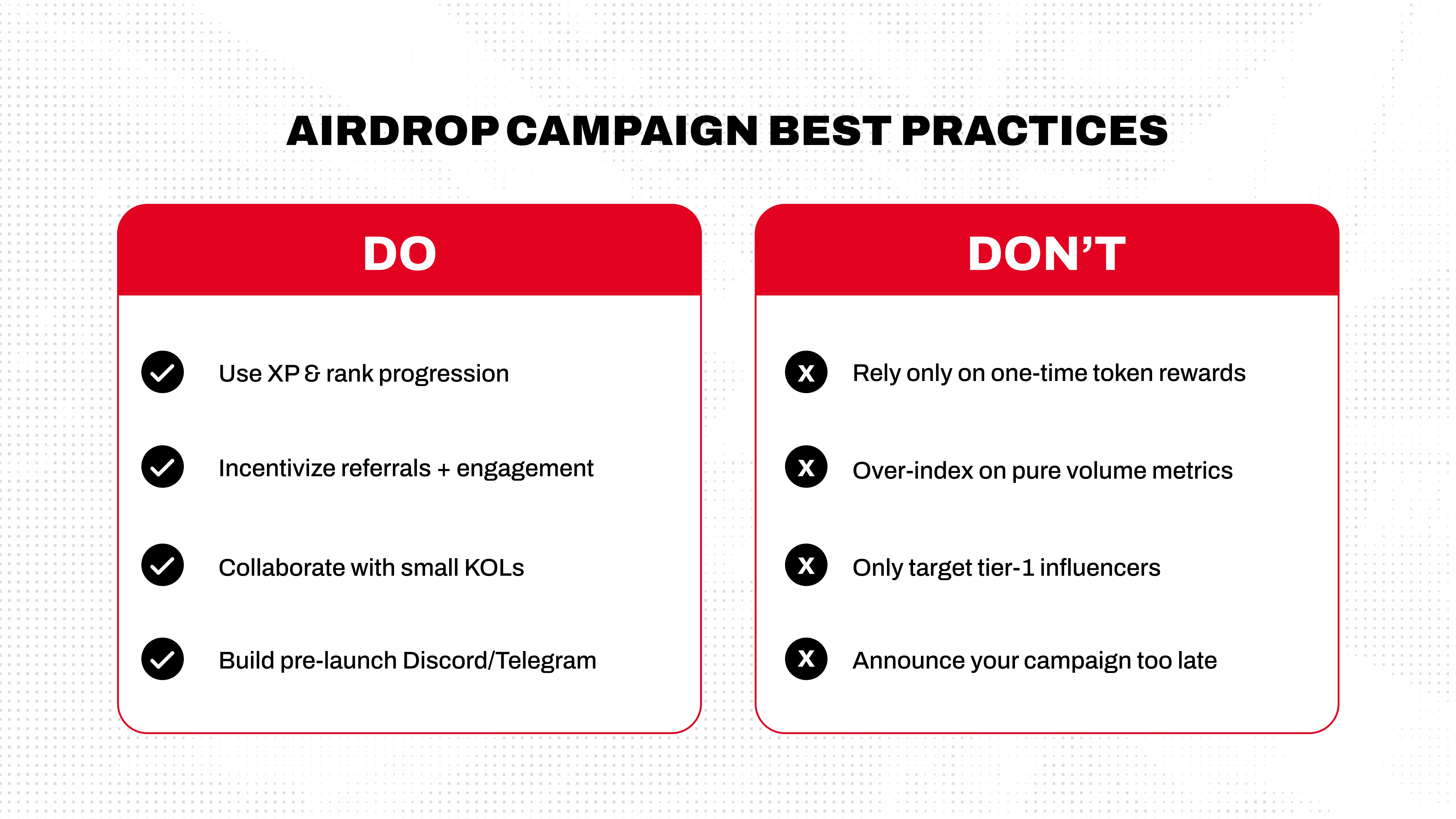
Copy-paste points metas: Without context, they’re noise.
Rewarding everything: If every action earns XP, users will optimize for spam.
Front-loading incentives: Big splash, no staying power.
Missing feedback loops: No way to adjust based on what’s working.
Final Thought
Good airdrops don’t feel like campaigns, they feel like games worth playing. If your airdrop needs a tweet thread to explain it, you’ve already lost half your audience. If it builds habits, social proof, and identity, you’ll build more than just TVL. And remember, an airdrop needs to keep the user's attention and most importantly, RETENTION. We will talk in another article about how to retain a user after the aridrop event.
Want to stay ahead of the airdrop curve? Subscribe to the Radarblock RaaS newsletter. We share real campaign lessons, growth frameworks, and practical Web3 marketing insights without the fluff.